
Project Overview: Supporting Uganda’s Secondary Education Expansion
Under the framework of the Uganda Secondary Education Expansion Project (USEEP) supported by the Ministry of Education and Sports (MoES) and international development funding from the World Bank, secondary education enrollment across Uganda has expanded rapidly. In response to the growing student population in major regional hubs including Kampala, Gulu, Mbarara, Jinja, and Mbale, educational authorities initiated a competitive public tender to furnish 24 newly constructed and renovated public secondary schools. The procurement package required 9,600 sets of double student desks and chairs, 240 teacher workstation sets, and 1,200 units of heavy-duty auditorium seating for multi-purpose assembly halls, with a total project budget valued at approximately 3.8 billion Ugandan Shillings (UGX) / 1.02 million USD.
As an experienced wholesale school desks and chairs factory, our engineering and manufacturing team was selected by the designated general contractor to deliver the complete furniture package. The primary objective was to replace fragile local timber benches with standardized, ergonomically certified, and climate-resilient classroom furniture that complies with international ISO 9001, EN 1729, and East African Community educational facility standards. Official guidelines from the Uganda Ministry of Education and Sports USEEP Project and educational development milestones documented by UNESCO Uganda emphasize that classroom physical infrastructure directly correlates with student retention and academic performance across Sub-Saharan Africa.

Navigating Ugandan Climate Challenges with Engineered Material Countermeasures
Uganda’s equatorial climate presents severe durability challenges for school furniture, characterized by bi-annual rainy seasons, high ambient humidity in the Lake Victoria basin, pervasive red laterite dust during the dry season, and subterranean termite activity. Standard commercial furniture constructed with unprotected carbon steel and low-density particleboard typically deteriorates within two academic terms due to structural corrosion and moisture expansion. To guarantee a minimum service lifespan of 10 years under intensive classroom use (often accommodating 50 to 60 students per room), our engineering team implemented rigorous material specifications detailed in our technical guide on the selection of school desk materials for African climates.
For the metallic framework, we utilized 1.5mm thick cold-rolled tubular steel subjected to a multi-stage pre-treatment process comprising degreasing, acid pickling, hot-dipped zinc phosphating, and electrostatic epoxy-polyester powder coating at a thickness of ≥80μm cured at 200°C. This surface treatment achieved over 500 hours of neutral salt spray testing (ASTM B117) without blistering or oxidation. For the desk tops and chair seats, we discarded conventional chipboard in favor of 18mm high-density moisture-resistant plywood surfaced with high-pressure laminate (HPL) and sealed with hot-melt polyurethane seamless edge banding. This composite construction completely isolates the core wood fibers from environmental humidity and prevents termite infiltration, while heavy-duty injection-molded nylon floor glides protect both the steel legs and classroom concrete screed floors.
Optimized Container Loading and Intermodal Freight Logistics to East Africa
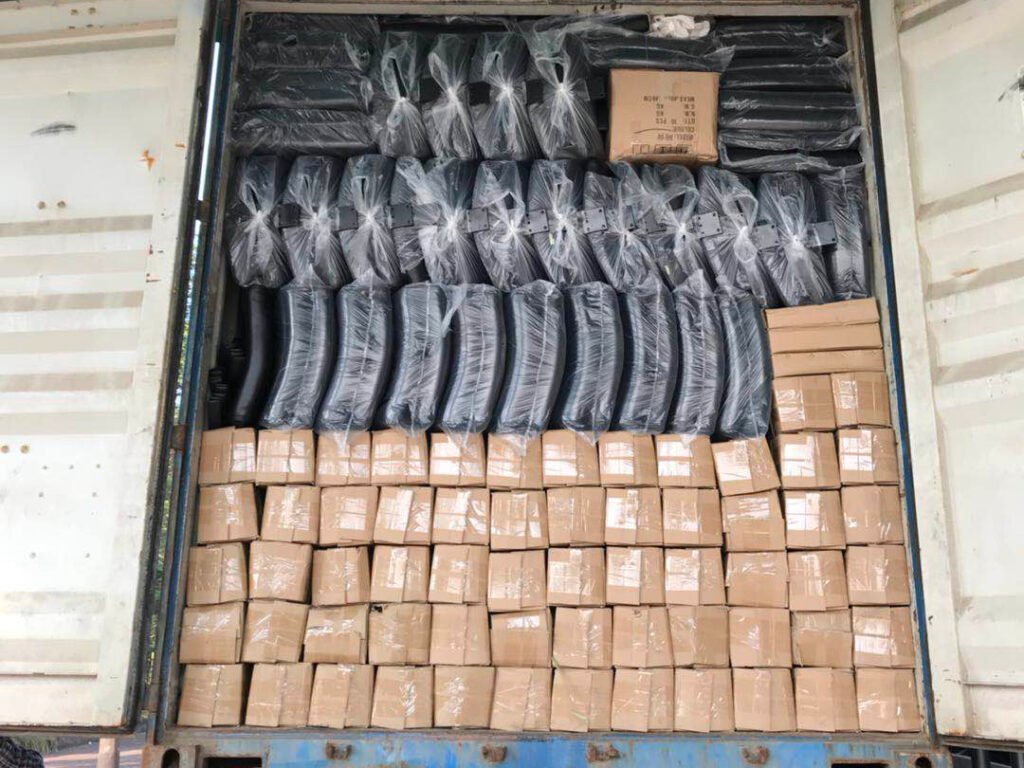
Logistical planning for landlocked East African destinations requires precise container space utilization and robust export packaging to withstand extensive maritime transport and overland road haulage. The 9,600 student desk sets, teacher desks, and assembly hall seats were manufactured at our production facility in Foshan and shipped across the Indian Ocean to the Port of Mombasa, Kenya, followed by transit along the Northern Corridor highway directly to consolidated distribution warehouses in Kampala, Mbarara, and Gulu. To minimize shipping costs and maximize container volume efficiency, we engineered a modular knock-down (KD) structure with precision nesting capabilities.
By implementing standardized palletization and nested component configurations outlined in our container loading and freight planning for African school projects, our logistics team packed 850 sets of double student desks and chairs into each 40-foot High Cube (40HQ) shipping container—a 35% improvement over pre-assembled alternatives. Across a total fleet of 14 x 40HQ containers, freight expenditures were reduced by over 38,000 USD, allowing the procurement committee to allocate additional capital toward supplementary STEM laboratory stools and library shelving. Every shipping unit adhered strictly to international export packaging standards for damage prevention, utilizing 5-layer corrugated export cartons, EPE foam edge protectors, and waterproof PE shrink-wrapping to prevent humidity absorption during maritime transit.
On-Site Assembly, Quality Assurance, and Handover Across Multi-Site Campuses
Delivering furniture across 24 school sites located across multiple districts presented complex multi-point installation challenges. Project deadlines were tied strictly to the commencement of the new Ugandan academic term under National Development Plan III (NDP III) targets. To ensure rapid and flawless deployment, we provided bilingual (English/Swahili) step-by-step assembly manuals, high-definition video tutorials, and dedicated color-coded hardware kits containing calibrated pneumatic fasteners and universal Allen keys. Furthermore, we dispatched a senior technical supervisor to conduct on-site train-the-trainer workshops for local assembly teams in Kampala and Jinja.
Each double desk set was assembled in less than 7 minutes using pre-threaded internal steel expansion bolts that eliminate the loosening risks associated with direct wood tapping screws. Before final client sign-off, joint inspection delegations comprising MoES district education officers, school headteachers, and independent quality auditors performed rigorous structural and safety audits across 100% of sample lots. All furniture units demonstrated complete compliance with static load requirements (150kg load capacity on desk surfaces and 200kg vertical force on chair seats) with zero surface burrs, exposed sharp corners, or coating defects, achieving 100% first-pass acceptance across all 24 campuses.
Post-Delivery Warranty Support and Long-Term Value for African School Tenders
Public sector institutional furniture procurement demands reliable after-sales accountability and spare parts availability. As part of our comprehensive B2B supply commitment, every shipment included a complimentary 3% critical spare parts package (replacement nylon feet glides, spare desktop screws, HPL edge-banding strips, and touch-up paint pens) stored directly at regional district education offices. Our structured warranty protocol provides a 5-year structural warranty on all welded steel frames and a 3-year warranty on laminate surfaces, backed by direct factory engineering support and rapid component replenishment channels.
The successful handover of this 24-school secondary education project in Uganda demonstrates the strategic advantages of partnering with an experienced Chinese school furniture manufacturer capable of integrating custom engineering, climate-specific material selection, efficient containerized freight, and reliable tender documentation. For institutional contractors, NGO procurement officers (UNICEF, UNDP, World Bank), and ministry project managers planning educational infrastructure upgrades in East and West Africa, JV School Furniture delivers turnkey manufacturing solutions tailored to local budget constraints and harsh operational environments.