
Project Background: Supporting Ghana’s Free Senior High School Infrastructure Expansion
Under the flagship Free Senior High School (Free SHS) initiative administered by the Ministry of Education (MoE) Ghana and the Ghana Education Service (GES), secondary school enrollment has surged across the nation. To accommodate this unprecedented influx of students across urban and regional educational centers—including Accra, Kumasi, Tamale, Sekondi-Takoradi, and Cape Coast—the government launched an international competitive procurement tender. The project was co-financed through national infrastructure development allocations and multilateral donor support, including the World Bank’s Ghana Accountability for Learning Outcomes Project (GALOP). The procurement mandate called for 8,200 sets of heavy-duty single student desks and chairs, 220 teacher workstation sets, and 1,100 units of heavy-duty auditorium seating for newly built campus assembly halls, representing a total contract valuation of approximately 15.6 million Ghanaian Cedi (GHS) / 1.15 million USD.
As an established institutional school furniture manufacturer with extensive African export experience, our engineering and production team was contracted to manufacture and deliver the entire furniture package. The core project objective was to transition regional classrooms away from fragile local wooden benches toward durable, standardized, and ergonomically certified classroom furniture complying with international ISO 9001 and EN 1729 standards. Strategic educational development frameworks outlined by UNICEF Ghana and country progress benchmarks published by UNESCO Ghana demonstrate that high-quality, standardized classroom furniture directly enhances student attentiveness, reduces absenteeism, and protects public capital investment across Sub-Saharan Africa.

Climate-Resilient Material Engineering Against Marine Salt Spray and Harmattan Dust
Ghana’s diverse geography presents extreme climatic stressors that accelerate physical wear on educational furniture. Coastal cities like Accra, Cape Coast, and Sekondi-Takoradi experience persistent relative humidity exceeding 85% coupled with corrosive airborne marine salinity. Conversely, the Northern Region around Tamale is subject to intense Harmattan winds carrying abrasive silica dust particles and extreme temperature swings, while subterranean termite infestation remains a widespread hazard across tropical zones. Standard retail school furniture fabricated from untreated mild steel and ordinary particleboard typically suffers severe structural failure and surface blistering within two academic terms. To guarantee a minimum operational lifespan of 10 years, our engineering team deployed customized material solutions detailed in our comprehensive guide on how to choose school desk materials for African climates.
For all structural framework components, we selected 1.5mm thick high-tensile cold-rolled tubular steel. Prior to surface finishing, all metal parts underwent a specialized multi-stage pre-treatment regimen consisting of industrial solvent degreasing, acid rust descaling, and high-density zinc phosphating. The frames were then electrostatically coated with thermosetting epoxy-polyester powder at a thickness of 80 to 100 microns and cured at 200°C, successfully passing 500 hours of continuous neutral salt spray exposure tests (ASTM B117) with zero oxidation. For tabletops and chair seats, we utilized 18mm high-density moisture-resistant E1-grade plywood cores faced with scratch-resistant High-Pressure Laminate (HPL) and sealed with hot-melt polyurethane (PU) seamless cast edging. This impermeable barrier completely blocks moisture penetration and termite attacks, while UV-stabilized polypropylene seat shells ensure zero color fading or embrittlement under intense tropical sunshine.
Container Space Optimization, Export Packaging, and Maritime Freight to Tema Port
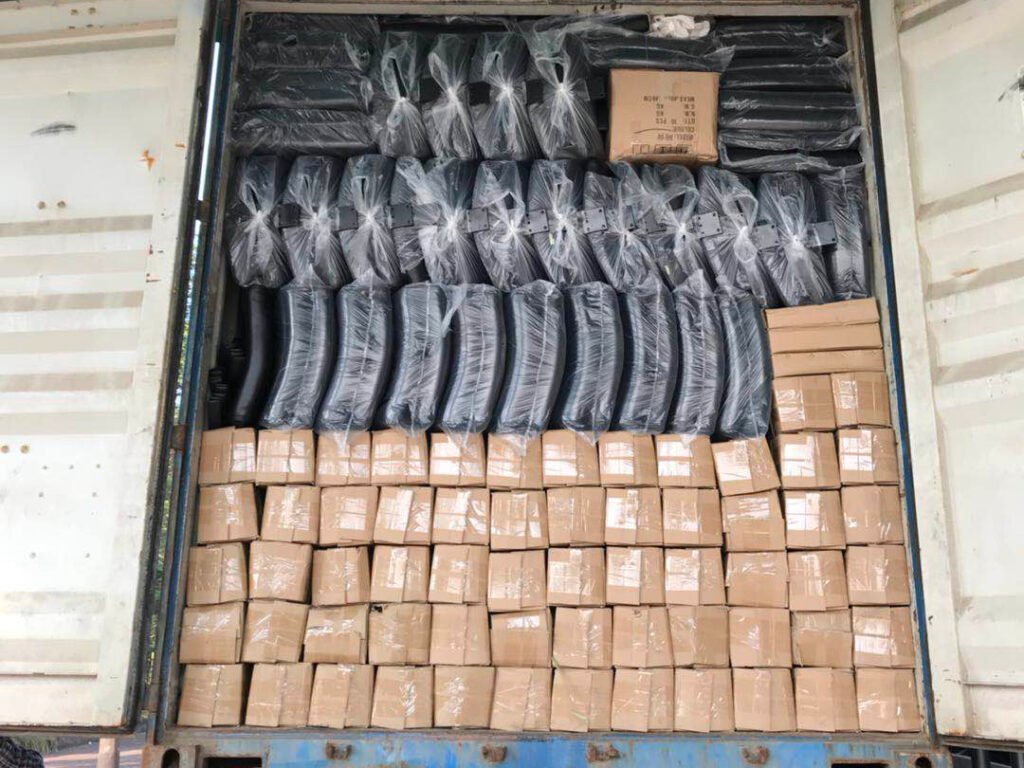
Logistical execution for bulk institutional tenders requires sophisticated container packaging engineering to minimize ocean freight expenditures and ensure zero-damage arrival. The 8,200 student desk sets, teacher workstations, and auditorium seating units were manufactured at our specialized production base in Foshan and routed via ocean freight directly to the Port of Tema, Ghana’s primary maritime gateway. From Tema, cargo was dispatched via organized overland truck convoys along national transit corridors to regional distribution staging hubs in Greater Accra, the Ashanti Region, and the Northern Region. To control landed logistics costs, our engineers developed a modular knock-down (KD) design that allows high-density nesting of steel leg assemblies and flat-packed desktop panels.
By implementing standardized palletization and nesting protocols established in our container loading and freight planning for African school projects, we achieved a loading capacity of 900 complete single desk and chair sets per 40-foot High Cube (40HQ) shipping container—a 33% increase over semi-assembled packaging configurations. This engineering optimization compressed the entire shipment into 11 x 40HQ containers, yielding freight savings exceeding 32,000 USD for the procurement consortium. In strict compliance with international export packaging standards for damage prevention, every carton was fabricated from heavy-duty 5-layer corrugated kraft paper with reinforced EPE foam corner protectors, internal moisture-absorbing silica desiccant pouches, and outer waterproof polyethylene stretch wrapping to eliminate condensation damage during maritime transit through equatorial waters.
Regulatory Compliance, EasyPASS Pre-Export Verification, and Tender Documentation
Navigating customs clearance and statutory regulatory frameworks in Ghana requires absolute precision in conformity documentation. In accordance with Ghana Standards Authority (GSA) guidelines, all commercial shipments of educational goods must undergo the EasyPASS Pre-Export Verification of Conformity (PVoC) program. Prior to container sealing at our manufacturing plant, accredited international inspection bodies—such as SGS and Intertek—conducted exhaustive physical inspections, document verifications, and container stuffing oversight. These verification procedures culminated in the prompt issuance of official Certificates of Conformity (CoC), ensuring rapid customs clearance at Tema Port with zero demurrage penalties or inspection delays.
In addition to mandatory customs clearance documentation, international donor-backed tenders demand comprehensive factory qualification portfolios. Our tender submission dossier incorporated verified ISO 9001 (Quality Management Systems) and ISO 14001 (Environmental Management) credentials, factory mill test certificates for prime steel coils, and third-party mechanical laboratory test reports certifying compliance with EN 1729-1 (ergonomic dimensions) and EN 1729-2 (structural safety and fatigue resistance). Furthermore, chemical test certificates verified that formaldehyde emission levels complied strictly with E1 standards (EN 717-1) and surface coatings were 100% free of lead and heavy metals under EN 71-3 regulations. As highlighted in our school furniture export certificates and compliance guide, maintaining meticulous documentation dossiers protects institutional contractors against administrative rejections and guarantees prompt payment milestone disbursements under commercial letters of credit.
Multi-Site Assembly Coordination, Quality Handover, and Long-Term Warranty in West Africa
Deploying school furniture across 18 separate Senior High School campuses situated in distinct geographical districts demanded seamless on-site assembly coordination. With tight delivery deadlines aligned to the commencement of the new Ghanaian academic calendar, our engineering department supplied bilingual English installation manuals, step-by-step video tutorials, and color-coded hardware blister packs containing specialized pneumatic driving bits and heavy-duty assembly bolts. We also coordinated technical webinars with the general contractor’s local assembly crews in Accra and Kumasi, standardizing installation workflows so that each single desk and chair set was fully assembled in under 6 minutes.
During the final site acceptance phase, joint verification teams comprising GES regional education directors, school headmasters, and independent supervising engineers conducted rigorous physical load and safety inspections across 100% of delivered batches. Every student desk demonstrated total stability under 150kg static surface load tests, while chair structures withstood 200kg vertical force impacts without joint deflection or weld fracture. To guarantee ongoing operational reliability, JV School Furniture provided a complimentary 3% emergency spare parts buffer (including replacement nylon leveling glides, spare assembly hardware, and matching touch-up paint pens) distributed directly to regional school storehouses. Backed by our comprehensive school furniture warranty and after-sales support FAQ—featuring a 5-year structural warranty on steel frames and a 3-year warranty on laminate surfaces—this landmark project stands as a benchmark for durable, cost-effective educational infrastructure delivery in West Africa.