Choosing school classroom furniture for educational projects across Sub-Saharan Africa requires balancing budget constraints, harsh environmental conditions, and long-term durability. Educational ministries and private school operators across cities like Lagos, Nairobi, and Accra often struggle with premature desk failure caused by high humidity, intense UV exposure, and heavy daily student use. Selecting the right classroom desks, chairs, and specialized seating is not merely an aesthetic choice; it directly determines student ergonomics, classroom flexibility, and overall procurement return on investment.
Matching student age groups and ergonomic standards
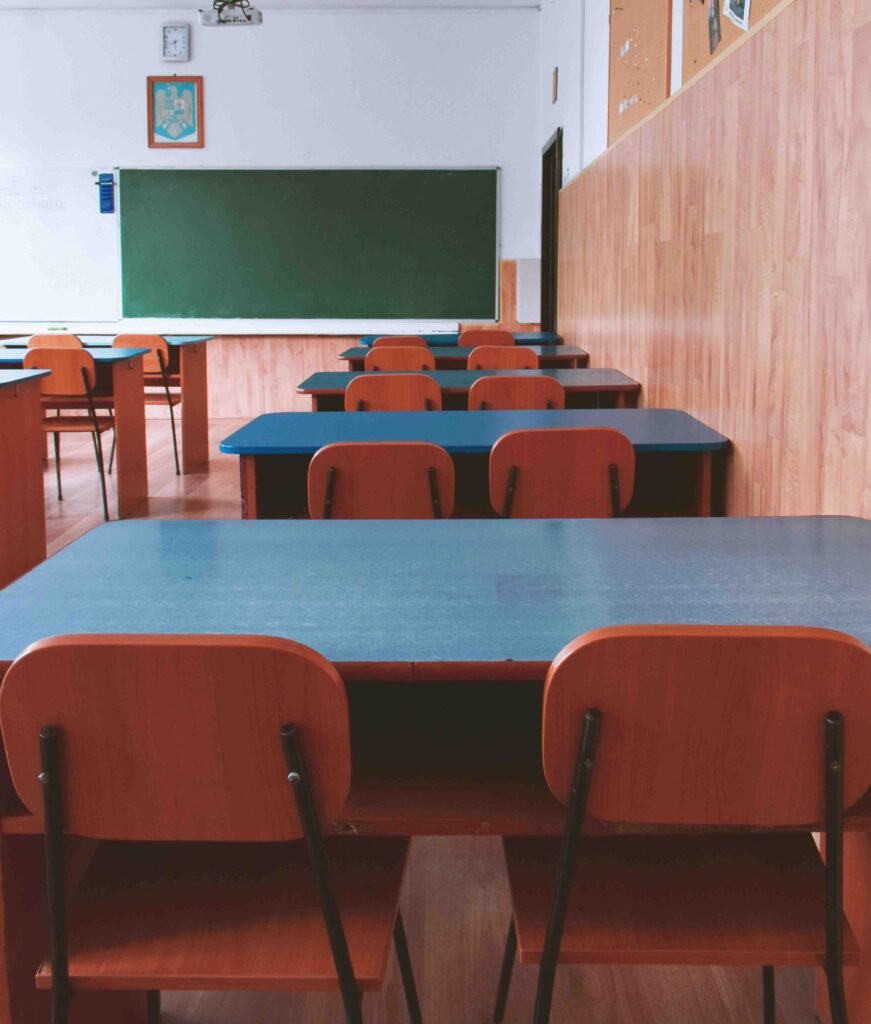
Classroom furniture must match the developmental stages of students to support proper posture, reduce fatigue, and foster classroom engagement. When selecting furniture for primary, junior secondary, and senior secondary institutions, buyers must specify appropriate desk heights, seat depths, and functional features. Primary school environments benefit from flexible, height-adjustable units that accommodate rapid growth spurts across mixed-age grades. Senior secondary and tertiary classrooms require robust single-student desk and chair configurations that maximize individual workspace while fitting standard classroom dimensions. Standardizing furniture dimensions according to international ergonomic standards ensures proper spinal alignment and minimizes classroom discomfort. For standard individual student seating specifications, review our single student desk and chair specifications and explore our height-adjustable student desk options for multi-grade flexibility. Large multi-purpose educational halls and lecture spaces require dedicated auditorium seating engineered for high-density occupancy and commercial durability.
| Educational Level | Typical Age Range | Recommended Desk Height | Seating Configuration |
|---|---|---|---|
| Primary Education | 6 to 11 years | 580 mm to 640 mm | Height-adjustable single or double desk |
| Junior Secondary | 12 to 14 years | 700 mm to 730 mm | Fixed single desk with integrated book box |
| Senior Secondary | 15 to 18 years | 750 mm to 760 mm | Heavy-duty steel frame single student unit |
| Lecture / Hall | Tertiary & Assembly | 750 mm | Floor-fixed tiered auditorium seating |
Material selection against tropical climate pain points
Environmental durability is the single most critical factor when procuring classroom furniture for tropical and coastal regions. Coastal hubs such as Abidjan, Douala, and Mombasa experience relative humidity levels exceeding 80 percent alongside salt-laden sea air, which rapidly accelerates red rust formation on unprotected steel frames. Inland and Sahelian zones, including Kano and Bamako, face intense harmattan dust seasons, extreme seasonal temperature swings, and severe termite activity. Standard commercial furniture finishes quickly degrade under these conditions, leading to chipped paint, swollen particle board, and structural collapse within two academic semesters.
To prevent premature failure, procurement specifications must mandate cold-rolled steel tubing with a minimum wall thickness of 1.2 mm, treated through multi-stage acid washing, phosphating, and electrostatically applied epoxy powder coating cured above 180 degrees Celsius. For wooden and composite components, buyers must reject standard raw particleboard in favor of high-pressure laminate (HPL) with heat-sealed polymer edges or blow-molded high-density polyethylene (HDPE). Solid wood components must be kiln-dried to an 8 to 12 percent moisture content and vacuum-treated against subterranean termites before export to prevent seasonal warping.
| Material Type | Vulnerability in Tropical Climates | Engineered Countermeasure | Expected Lifespan |
|---|---|---|---|
| Steel Tubing | Coastal salt-spray oxidation and corrosion | Multi-stage phosphating + epoxy powder coat | 8 to 12 years |
| Desktop Surface | High ambient humidity and edge swelling | High-Pressure Laminate (HPL) with PU edge | 7 to 10 years |
| Seat & Backrest | Impact cracking and intense UV degradation | Virgin blow-molded HDPE with UV stabilizers | 8 to 10 years |
| Solid Timber | Termite infestation and moisture warping | Kiln drying (8-12% MC) + borate preservative | 10 to 15 years |
Logistics planning and knock-down container loading efficiency
International freight costs represent a substantial percentage of total classroom furniture procurement budgets for African buyers. Shipping fully assembled desks and chairs consumes excessive container volume, dramatically inflating per-unit landed costs and increasing transit damage risks during multi-modal inland haulage. Export-grade classroom furniture must be engineered with knock-down (KD) construction, allowing modular components, steel leg frames, and desktop panels to stack compactly and nest tightly inside ocean shipping containers.
A standard 40-foot high cube (40HQ) ocean container provides approximately 65 cubic meters of usable cargo volume. When properly designed for knock-down packaging, a 40HQ container can accommodate 850 to 1,000 sets of single student desks and chairs, compared to fewer than 350 fully assembled sets. Efficient container packing significantly reduces ocean freight and port handling fees per desk set, leaving more budget for classroom expansion. Proper flat-pack cartons also protect powder-coated metal edges from in-transit abrasion across bumpy inland corridor transit. Before finalizing shipment volumes and tender bill of quantities, calculate your precise container utilization with our technical guide to calculating container loading for student desks and chairs.
Quality verification and pre-shipment inspection protocols
Procurement teams must enforce strict factory quality control and pre-shipment inspection protocols to ensure delivered goods match tender technical specifications. Once shipping containers arrive at inland clearance depots in cities like Lusaka, Harare, or Kigali, returning defective merchandise to overseas factories is practically impossible and commercially unfeasible. Establishing third-party factory audits and rigorous pre-shipment inspection checklists protects buyers from substandard steel gauges, defective welds, missing hardware packages, and improper protective packaging.
Factory testing should include structural drop tests, static load testing of chair frames up to 150 kilograms, and cross-hatch paint adhesion testing to verify epoxy powder coating integrity. Additionally, inspect carton export labeling, humidity desiccant placement, moisture barrier wrapping, and spare parts allocations (typically 2 percent of total bolt and fastener count) prior to container sealing. For a detailed pre-shipment checklist covering essential export quality checks and container loading verification, review our school furniture inspection FAQ before shipment to prepare your inspection team.
Aligning procurement with national education policies and funding
Large-scale educational furniture procurement across Africa is closely tied to national strategic development plans and international donor financing. In Côte d’Ivoire, compulsory basic education initiatives drive nationwide primary classroom expansion funded under national development budgets and regional development banks. In Senegal, the PAQUET-EF 2018–2030 educational sector program allocates substantial resources to modernize secondary school infrastructure and expand vocational institutions. Similarly, in Kenya and Ghana, government capitation grants and donor-backed infrastructure programs funded by the World Bank, the African Development Bank, and the Global Partnership for Education require strict adherence to competitive public tender guidelines and transparent technical evaluation criteria.
The urgency for durable classroom infrastructure is highlighted by international development benchmarks. UNICEF data indicates that nearly 70 percent of 10-year-olds in low- and middle-income nations face foundational learning challenges, where inadequate physical learning environments and seating shortages severely hinder educational outcomes. Furthermore, UNESCO reports that 273 million children and youth globally remain out of formal schooling, driving intensive school construction and classroom rehabilitation across developing regions. Aligning your procurement specifications with institutional tender standards ensures compliance with donor procurement frameworks and avoids project delays. For customized tender specifications, factory pricing, and comprehensive project scheduling, submit your project requirements to our Africa B2B quote desk for a complete quotation.